
Temporary disruption to some CRG online services. Several CRG websites and online services are temporarily unavailable, including our Technology Transfer and Recruitment websites and the registration forms for events and courses. We are working to restore them as soon as possible and apologise for any inconvenience.
 To determine whether Wnt/β-catenin-dependent reprogramming of fused cells is a mechanism of regeneration in higher vertebrates
We will determine whether Wnt/β-catenin signalling controls in-vivo reprogramming of hybrids formed in response to injury. We will transplant perturbed (Wnt-activated or repressed) adult stem cells into a variety of drug-induced or genetically modified damaged organs. Short-term and long-term regeneration will be studied. Genetic approaches will be used to evaluate cell fusion, reprogramming and regeneration in the tissues analysed.
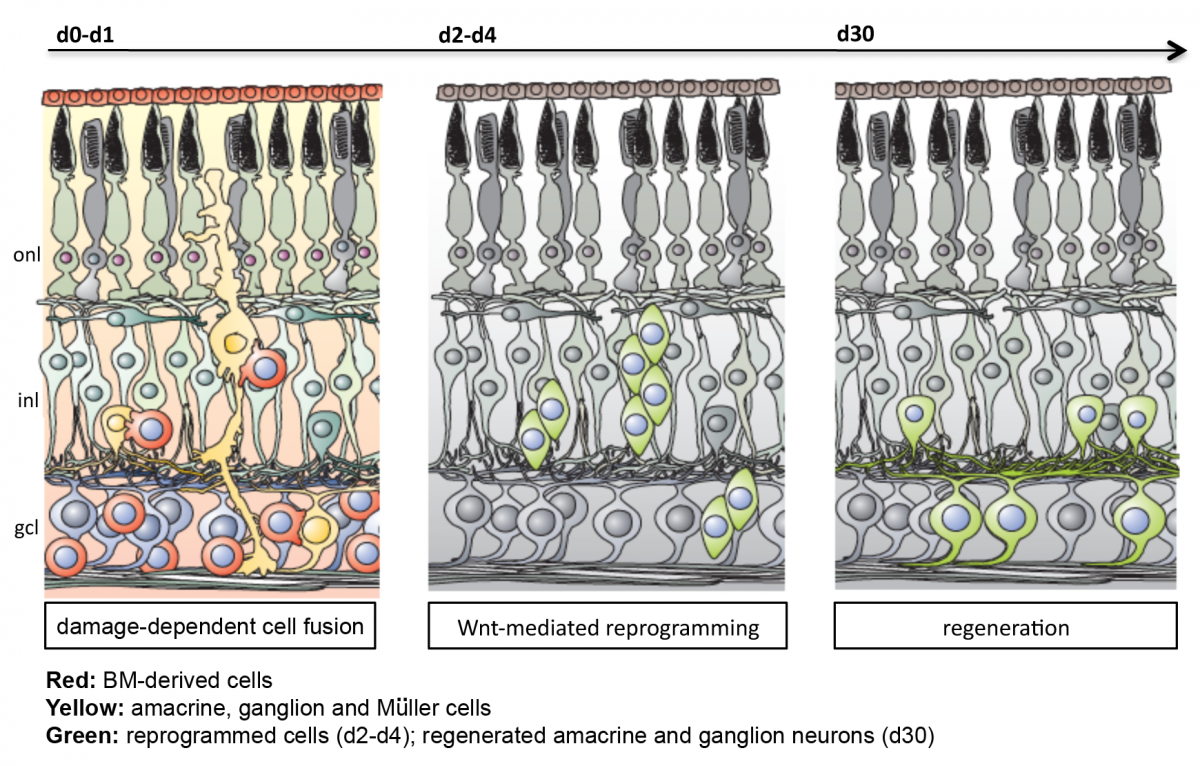
Figure above: Cell fusion mediated regeneration of retinal neurons. Taken from Sanges et al. Cell Reports 2013