
 NEWS
NEWS
The restless fish missing tiny genetic fragments in the brain
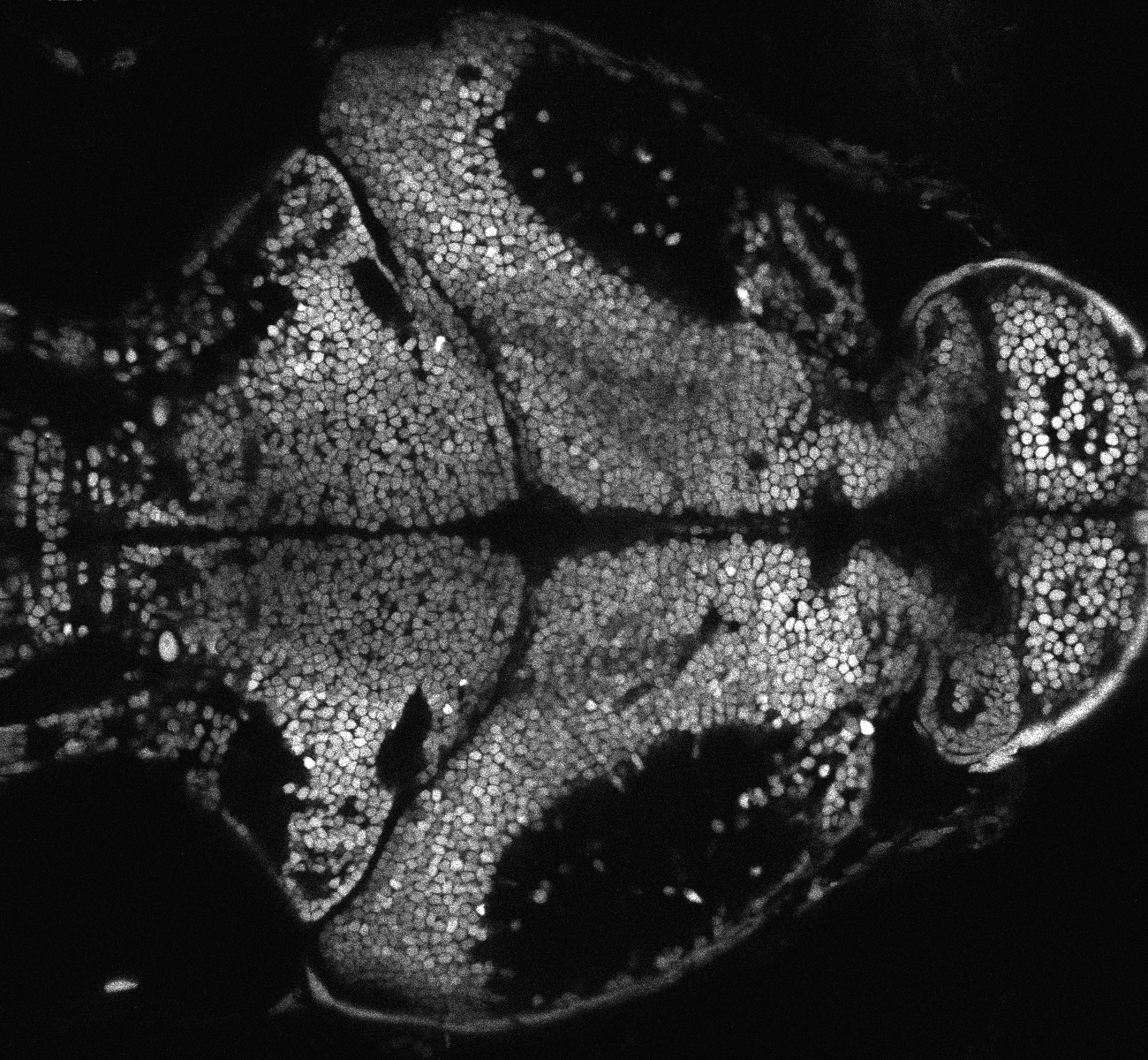
Calcium levels in brain cells. Technique used to measure neuronal activity, in which the most active cells appear brighter. Credit: UPF - CRG
The machine kept breaking down.
It was February in 2021, and Tahnee Mackensen was a PhD student in her first real experiment. She had come to a small biotech company in the outskirts of Barcelona which owned a piece of equipment her lab back at the CRG did not yet possess.
It was a behavioural tracking system that could film zebrafish larvae through a night and tell her, frame by frame, when each one was sleeping and when each one was awake. Mackensen would place her mutant larvae into the wells of a plate and let the machine watch them sleep.
The machine did not cooperate. Some nights it gave her four uninterrupted hours of data. Some nights, two. Some nights, one.
But even in those broken fragments, she found an interesting pattern.
"It was really stark, the difference of the mutant just sleeping a lot less," Mackensen would later recall. "Even though I got only like hourly chunks, it was good enough to say, okay, let's buy the machine ourselves."
The fish she was watching were missing the ability to splice in a class of genetic fragments so small that, for decades, biologists had largely overlooked them. They are called microexons, and the longest of them is no bigger than a tweet's worth of code. Their existence had been properly described only twelve years earlier, in a landmark paper from the same lab Mackensen had just joined.
What that paper had shown was that these tiny fragments, just three to fifty-one letters long, and sometimes coding for just a single amino acid, were almost exclusively switched on in neurons, almost perfectly conserved across hundreds of millions of years of vertebrate evolution, and quietly misspelt in the postmortem brains of people with autism.
What the study had not shown was what happened when you took the whole program away. That was the question Mackensen had set out to answer. And despite the temperamental machine, an answer began to surface: the fish were restless. Five years after the initial experiments, the team have published their findings in Science Advances.
A vocabulary the brain reserves for itself
To understand what Mackensen was looking at, it helps to understand that a gene produces a draft instead of a finished sentence. First, the stretch of DNA is broken into chunks called exons, separated by sequences that get cut out before the message reaches the cell's protein-making machinery. The cell decides which exons to keep and which to leave behind.
The same gene, edited two different ways, can produce two subtly different proteins. Also known as alternative splicing, the biological process is one of the main reasons that humans, who have only about twenty thousand genes, can build something as complex as a brain or pancreas.
Most exons are dozens or hundreds of letters long, but scattered through the genome are tiny exons, known as microexons, that went largely ignored until they were discovered by a team led by Manuel Irimia, now Mackensen's supervisor, in 2014.
Further studies linked individual microexons to individual functions. The PhD student who preceded Mackensen in the lab, Laura Lopez-Blanch, had spent years engineering zebrafish in which a single microexon was deleted at a time. Most of those mutants barely showed a phenotype, with the effects real but subtle, individually almost invisible.
When Mackensen joined the lab, the initial idea had been to follow Lopez-Blanch's example and pick one of the more interesting single microexons and dig deeper. A previous PhD student in the lab, who had worked on microexons in mice, advised her to pick five, because four of them will probably show nothing. Irimia had a different suggestion. Why not, he proposed, go after the master regulator itself? A protein called Srrm3, which acts as the single switch that decides whether the entire microexon program gets included or skipped. Lose Srrm3 and you lose nearly all microexons at once.
The lab had already engineered such a line. Earlier work by Ludovica Ciampi had used it to study the retina, where the mutants developed photoreceptor problems. But nobody had asked how the fish reacted to the world. In a parallel project on fruit flies, the same lab had recently shown that disabling the equivalent splicing factor caused the flies to become restless. It was a tantalising hint that the question might be worth asking in zebrafish.
"We were like, okay, maybe we can see if there's also a sleep phenotype in these mutants in fish," Mackensen recalls. "And it'd be really cool because it would be kind of conserved."
The grammar of swimming
Zebrafish larvae are a gift for neuroscience. They are transparent. Five days after fertilisation, they swim, they hunt, they sleep, they startle, and they show something that looks, to the trained eye, very much like anxiety. Their arousal systems are organised much like a mammal’s, with dopamine and noradrenaline circuits that govern when a vertebrate is alert or drowsy. Because they are small enough to fit in well plates, scientists can track hundreds of them at once.
There was something else about zebrafish that struck Mackensen as she got to know them. Young larvae already speak a complete behavioural language.
"What I found very fascinating is actually how much behavioural depth is already in the larvae," she says. "They have different movement types that really reflect their internal states. They have predetermined patterns to some extent, but they also have a lot of flexibility. I thought that was really cool at this early stage, to see so much behaviour we would expect from adults."
That is critical for the experiment because if a young fish has a fixed vocabulary of swims, such as gentle forward glides, leisurely turns or violent escape twists, then any disruption to that vocabulary becomes a readable signal. A fish that uses the wrong word is a fish whose brain is in the wrong state.
To read the vocabulary properly, Mackensen needed equipment her lab did not have. So, one autumn she packed up her fish, stayed with a friend, and went to Lisbon for two weeks.
The lab of Michael Orger at the Champalimaud Foundation had, over the previous years, built a sophisticated zebrafish-tracking system. A high-speed camera recorded the larvae's tails at seven hundred frames per second, which was later classified into different swim types. After a collaborator and friend Thomas Soares Mullen showed her how to use the system, Mackensen got to work.
"You can really go very quickly from just recording the videos to getting the bout types," Mackensen says. "I went to the lab, I put the fish into the wells, I ran the post-processing. I also did all the analysis afterwards. I went in person two times for two weeks."
What the camera revealed was that Mackensen's mutants used the same vocabulary as their healthy siblings, but kept reaching for the words reserved for emergencies. The high-displacement turns, the violent escapes, the swim types a fish deploy in response to sudden darkness or stressful signals. And every so often, a mutant would erupt into a long movement that was not observed in controls.
The basement in London
By the autumn 2022, Mackensen had behavioural data and she had molecular data from the RNA sequencing of her mutants' neurons, which confirmed that hundreds of microexons across many different genes were being skipped.
Now, she needed a window into the brain itself. To see whether the mutant fish's neurons were actually firing differently, she needed a two-photon microscope, which her lab in Barcelona did not own, and a calcium-imaging pipeline that was robust and had been optimised over the years.
Isaac Bianco's lab at University College London has both, specialising in exactly this kind of work. They could watch whole brains light up in living, behaving zebrafish.
The catch was the fish themselves. To image a brain, you have to see through the skin, which means the fish cannot have pigment. Mackensen's mutants, like normal zebrafish, were pigmented. So, before any imaging could happen, the lab had to cross her line with one that allowed to see neuronal activity, a process that took nearly a year altogether.
What followed was, by her account, three months of grinding.
"It was quite hard to identify the genotype of the fish beforehand," she says. "So, I had to image quite a few more, and I could do maximum three a day. I remember coming in nearly every weekend because I was just not getting the data."
The data showed just how much the zebrafish brains were buzzing. Even when nothing was happening, the neurons in their brains were firing more often and in larger bursts than the neurons of non-mutant siblings.
Mackensen had her fish, her swims, and now her neurons. What she didn't have was the mechanism. What was causing all of this?
A stolen laptop, and a turn no one expected
The idea, when it came, arrived in the most typical Barcelona fashion possible. Mackensen's laptop got stolen. For several weeks, she could not run analyses.
She had recently finished a small drug screen, using two compounds, clonidine and ropinirole, chosen because they targeted the noradrenaline and dopamine arousal systems respectively. The drugs calmed both wild-type fish and the mutants, meaning the effect wasn’t specific to rescuing microexon splicing.
Now, without a laptop, she read. And as she read, she realised the two drugs she had used converged downstream on a single molecule. Both ultimately lowered the levels of a small intracellular signal called cyclic AMP, or cAMP.
"This was really like the moment when it pivoted to cyclic AMP," she says. "It was kind of nice because it was weirdly unexpected. I hadn't really thought about which arousal drugs to use. I was more like, okay, test a few arousal systems. And then it came from me basically doing lots of reading on the drugs I had."
cAMP is one of the most well-known signalling mechanisms in cellular biology. It’s a small molecule that sits at the crossroads of dozens of signalling pathways and acts, in neurons, as a thermostat for activity. When it goes up, cells become more excitable and when it goes down, they quiet.
If both drugs were lowering cAMP, and the mutants were less sensitive to them than healthy fish were, then maybe the mutants already had too much cAMP activity, pushing back against the drugs and keeping the fish restless.
She tested the hypothesis directly. First, she gave healthy fish a drug called forskolin, which boosts cAMP. The healthy fish became hyperactive, behaving like her mutants. Then she tried the reverse experiment, on the mutants, with a compound called SQ22536, which blocks cAMP synthesis at the source.
She analysed the result on a train, heading out to the beach for a weekend. "I saw the plot in the train and I sent it to Manu," she recalls. "I was like, look at this, look at this."
The mutants had become normal. Their hyperactivity, their restlessness, their refusal to settle had been restored. Healthy fish given the same compound were essentially unaffected.
Irimia, characteristically, was cautious. It could be a one-time effect. They would need to repeat it. Mackensen repeated the experiments and the results held. cAMP was a critical piece of the puzzle.
What's broken, exactly?
The hardest question in the paper, in some ways, is the one Mackensen still cannot fully answer. Srrm3 controls hundreds of microexons across hundreds of genes. Which of them, exactly, was driving the behaviour?
Her lab's previous work, deleting microexons one at a time, showed single-microexon mutants barely showed a phenotype. One, in a gene called rapgef2 that mediates cAMP signalling, partially reproduced daytime hyperactivity. Another, in a gene called ptprd, did the opposite and made fish sleep more.
The implication is that no single microexon is doing the heavy lifting. The hyperarousal emerges from the simultaneous, cumulative loss of dozens of small adjustments, each one trimming a protein here, a synaptic interaction there.
"Microexons kind of fine-tune processes during development," Mackensen says. "They keep each other in balance. One might be increasing activity, one might be decreasing it. One might allow a neurite to branch out more, some less. They usually seem to be doing kind of opposing things."
And the cells themselves seem to register the loss. The data shows genes whose microexons had been skipped were being produced at higher levels, suggesting that cells were trying to compensate by manufacturing more of the slightly-wrong product.
A long road and a careful line
Mackensen is careful about how far she draws the line to human conditions.
Microexon mis-splicing has been documented in postmortem brains from people with autism and with schizophrenia. Sleep disturbances and sensory hypersensitivity are among the most distressing symptoms in autism, while abnormal sensory processing is common in schizophrenia. But fish are not people and a master-regulator knockout in a larva is not a clinical disease.
What the paper offers is a potential mechanism. It says: if you disrupt this splicing program, as appears to happen in subtler ways in human brains affected by these conditions, here is one plausible chain that follows. Microexons get skipped. Proteins shift slightly. cAMP signalling tips into overdrive. Neurons enter a state of chronic over-alert.
The animal stops sleeping properly, stops habituating to small stimuli and stops being able to settle. But the study also shows the chain can be broken. Pharmacologically, in a fish, the hyperarousal phenotype is reversible.
When Mackensen first started the project, she did not know it would land here. She knew microexons had been implicated in neurodevelopmental conditions, and she hoped, at most, to see whether the fish's behaviour might resemble symptoms reported in autistic individuals. Getting from behaviour all the way down to a specific molecular pathway is the kind of thing that, in a PhD, you don’t expect.
The project is testimony to the idea that vertebrate biology can also illuminate human disease. As Mackensen’s research advanced, Irimia moved his lab to Pompeu Fabra University, while retaining a joint affiliation with the CRG, to establish a new Evolutionary Medical Genomics programme, an institutional commitment to the concept that what evolution has kept, medicine should pay attention to.
Microexons were worth studying because they had been preserved, almost unchanged, across hundreds of millions of years of evolution. The fly work pointed toward the fish work because the splicing machinery was conserved. The cAMP pathway is conserved across nearly every animal with a nervous system.
"In the end that we could narrow down to a pathway, I think it's already quite exciting," she says. "Especially since the pathway is also implicated in depression, anxiety. It's such a central arousal pathway. I think it's probably just the tip of the iceberg."