
 PRBB-CRG Sessions David Duffy
PRBB-CRG Sessions David Duffy
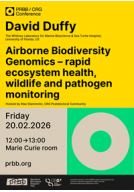
20/02/202612:00MARIE CURIEPRBB-CRG SessionsDavid DuffyThe Whitney Laboratory for Marine Bioscience & Sea Turtle Hospital, University of Florida"Airborne Biodiversity Genomics – rapid ecosystem health, wildlife and pathogen monitoring"Host: Max Stammnitz, Postdoc CommunityAbstract:Genomic technologies are changing our understanding of wildlife diseases, such as a sea turtle tumor panzootic (animal pandemic). Simultaneously, the convergence of advanced genomic sequencing technologies and innovative environmental sampling approaches are enabling discovery at whole biome scales and across the tree of life, from microbes to mammals.
Environmental DNA comprises trace amounts of genetic material shed by organisms as they traverse and interact with their environment. Genetic material can enter the environment from shed skin, hair, scales, bodily fluids, defecation and even with every exhaled breath. This genetic material can now be recovered from the air, water or sediment samples, and can reveal a wealth of information about a region’s inhabitants, including sea turtles, bobcats (lynx), mosquitoes, allergens and humans.
These rich eDNA genomics datasets can be used to non-invasively quantify the genetic material from each organism and understand what species are present, their origin, and their genetic diversity. These emerging technologies enable the simultaneous study of viral to vertebrate genetics, and unlock their genetic secrets for a wide variety of downstream applications. These include (1) biodiversity monitoring, (2) flora, fauna, funga and microbial population genetics, (3) pathogen and disease vector genomic surveillance, (4) allergen and narcotic surveillance, (5) antimicrobial resistance surveillance and (6) ecosystem-scale genome mining for drug discovery (bioprospecting).
eDNA genomics can also reveal novel human genetic variation and our findings highlight ethical considerations, especially given that analysis of human genetic diversity, disease risk, and genetic ancestry analyses are now possible from room air or outdoor air sampling alone.
This talk will cover how human cancer genomics approaches can be used to understand the causes of sea turtle tumors and develop novel eDNA technologies to monitor shifts in the occurrence of sea turtles and their pathogens in the wild. It will also cover recent advances in airborne DNA biodiversity genomics, discuss their implications, potential roadblocks to implementation, and explore their promise for diverse fields.
