
 PRBB-CRG Sessions Taro Kitazawa
PRBB-CRG Sessions Taro Kitazawa
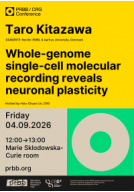
04/09/202612:00MARIE CURIEPRBB-CRG SessionsTaro KitazawaDANDRITE-Nordic-EMBL & Aarhus University"Whole-genome single-cell molecular recording reveals neuronal plasticity"Host: Hsiu-Chuan LinAbstract:Memory defines who we are. Converging studies propose that memories are allocated to a sparse ensemble of neurons, namely memory engram cells, that are activated during learning and reactivated during recall. However, only a limited fraction of learning-activated neurons is reactivated, and the cellular and molecular mechanisms that determine reactivation propensity remain unresolved.
In the first half of this seminar, I will focus on memory allocation during learning and present our single-cell (sc) multi-omics approach. After aversive memory formation, we collected the amygdala, prefrontal cortex, and hippocampus and performed 10x Genomics scMultiome (RNA plus ATAC) together with multimodal nanobody-scCUT&Tag (nanoCT; ATAC plus H3K27ac, H3K27me3, and FOS). By focusing on the epigenetic memory of neuronal activation, we identified learning-specific gene regulatory modules distinct from baseline activity, outlining regulatory programs by which neurons discriminate learning-relevant stimuli.
In the second half, I will introduce HisTrac-seq, a whole-genome history-tracing platform we developed to overcome the snapshot limitation of conventional single-cell sequencing. HisTrac-seq enzymatically labels adenines in genomic DNA to record past gene regulatory states, enabling “time machine”-like temporal multi-omics that links past and present molecular profiles within the same cells. We extended HisTrac-seq to sin-gle cells and discovered unexpected abrupt cell identity transitions during differentiation associated with al-terations in signaling and epigenetic states.
Finally, I will introduce our ongoing scHisTrac-seq study of memory, which links learning-induced molecular states to recall-time reactivation. This enables a direct comparison of reactivated versus non-reactivated neurons to uncover the epigenetic and transcriptional basis of ensemble reactivation - a core feature of the memory engram definition.
Reference:
Single-cell chromatin tracing reveals multimodal molecular programs during memory formation. Itoh, K., Khalil, V., Faress, I., Kitazawa, T. bioRxiv 2026 (https://doi.org/10.64898/2026.06.16.732522)
Whole-genome single-cell multimodal history tracing to reveal cell identity transition. Kawamura, KY., Khalil, V., Kitazawa, T. bioRxiv 2025 (https://doi.org/10.1101/2025.08.12.669973)
