
 Eric Latorre Crespo
Systems and Synthetic Biology
- Group page
- Research lines
- Group members
- Publications


Biosketch
Dec 2024-present Independent Fellow, Centre de Regulació Genòmica, Barcelona Collaboratorium for Mathematical Modelling and Predictive Biology, Spain
2024-present Junior Group Leader, Centre de Recerca Matemàtica, Spain
2023-2024 Postdoctoral Research Fellow, University of Glasgow - CRUK Scotland Institute, United Kingdom
2019-2024 Cross-Disciplinary Fellow, University of Edinburgh - Institute of Genetics and Cancer, United Kingdom
2018 Postdoctoral Research Fellow, Instituto de Ciencias Matemáticas, Spain
2013-2018 PhD in Mathematics, Universidad Autónoma de Madrid/ICMAT, Spain
Summary
Cellular aging refers to the progressive deterioration of cellular function over time. Unlike diseases with discrete initiating events, aging involves the slow, complex accumulation of molecular and cellular changes, requiring systems biology approaches and novel computational and mathematical methods. A central question is to characterize the fundamental mechanisms driving the diversity of aging phenotypes observed across scales: species, individuals, and cells.
My research addresses this challenge by developing mathematical frameworks that model aging hallmarks as emergent properties of stem cell dynamics. In clonal hematopoiesis (CHIP), I apply evolutionary population dynamics to track, in vivo, how somatic mutations accumulate and expand over time, revealing how individual-specific microenvironments modulate fitness and disease progression. For epigenetic aging, I conceptualize methylation changes as stochastic epimutations occurring during cell replication, connecting aging speed mechanistically to cellular turnover rates. This mechanistic framework transforms aging biomarkers from statistical correlations into quantitative measurements of fundamental cellular processes, opening new avenues for understanding what controls health- and lifespan variation across species and individuals.
Research Line 1: Clonal Hematopoiesis of Indeterminate Potential (CHIP)
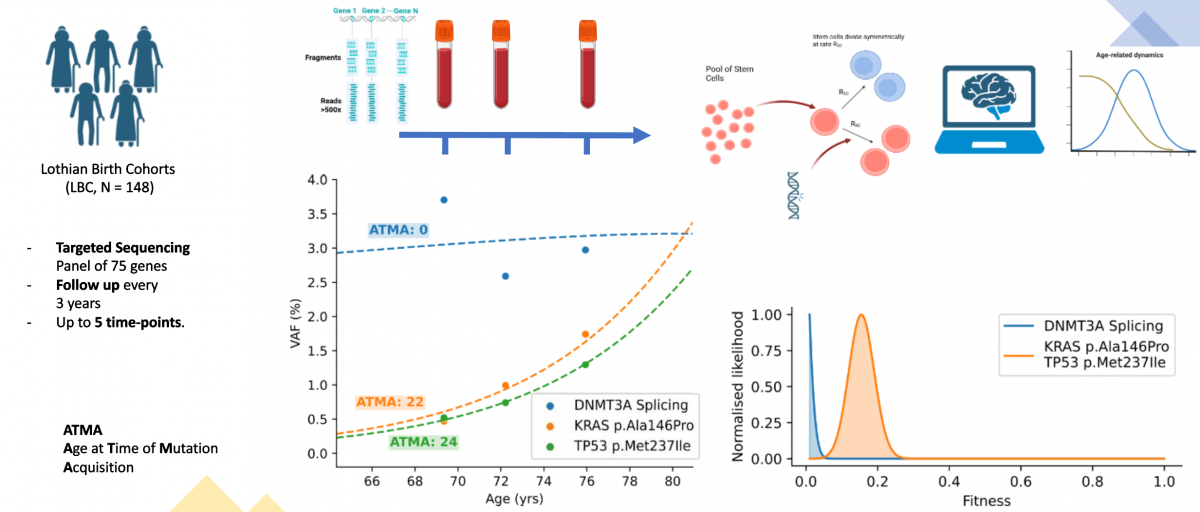
Clonal hematopoiesis of indeterminate potential (CHIP) is a pre-malignant state characterized by the accumulation of somatic mutations in hematopoietic stem cells (HSCs) and the expansion of genetic clones in blood. CHIP correlates with increased risk of hematological malignancies and cardiovascular diseases. However, conventional population-level analyses fail to account for inter-individual variations in clonal composition and mutation progression, limiting our ability to predict which individuals will progress to disease.
In this research line, we combine targeted error-corrected sequencing with mathematical modeling to track, in vivo, the longitudinal evolution of mutations at pre-clinical stages. By exploiting longitudinal dynamics, we aim to distinguish fitness-inducing mutations from neutral drift, resolve clonal hierarchies—determining whether mutations co-occur within the same HSCs or compete across different clones—and quantify how individual-specific bone marrow microenvironments modulate clonal expansion (Robertson et al., 2022, Nature Medicine; Latorre-Crespo et al., 2025, BioRxiv). More precisely, we seek to understand how mutation timing, fitness, and clonal structure interact to determine clinical progression and to produce novel biomarkers of mortality progression. For this, we closely collaborate with clinicians to develop strategies for risk stratification and follow-up guidelines in individuals presenting CHIP and therapy-related CHIP (Badar et al., 2025, Blood Advances).
Research Line 2: Epigenetic Aging – A Cellular Mechanics Perspective
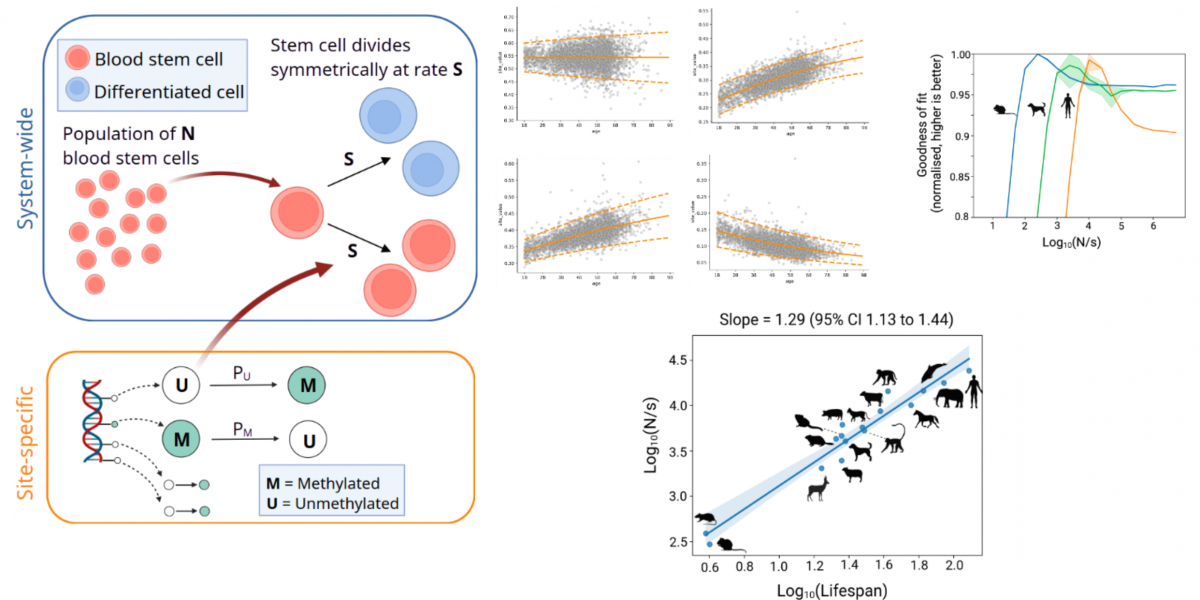
Epigenetic aging has emerged as the most reliable quantitative biomarker of biological age, showing strong associations with diverse phenotypes and diseases. However, while epigenetic clocks successfully assess aging speed across tissues and species, the fundamental processes driving aging speed have remained poorly understood.
In this research line, we develop cellular mechanisms-informed mathematical models of epigenetic aging, conceptualizing age-related methylation changes as stochastic shifts occurring during cell replication. This approach aims to provide mechanistic interpretability to epigenetic clocks by decomposing epigenetic aging rate into stem cell replication rate and methylation change probability per division (Dabrowski et al., 2024, Nature Aging). By testing whether differences in epigenetic aging rates across species reflect differences in stem cell dynamics, we discovered scaling laws linking DNA methylation rates to maximum lifespan across mammals, mirroring patterns observed for somatic mutations and telomere shortening (Crofts, Latorre-Crespo & Chandra, 2023, Nature Aging). Whether stem cell replication serves as an upstream regulator unifying multiple hallmarks of aging and its role in determining accelerations in epigenetic aging or the lifespan of species remains an open question which forms the basis of our research.
Group Leader
1Organizing and leading authors; contributed equally to this work; S. Manrubia is the corresponding author. A reply to comments was published in 2022 with the same co-authors.