
 CRG Scientific Sessions

22/10/202610:00R_473.10_AULACBHG Program SeminarJi Won OhDepartment of Anatomy, Yonsei University College of MedicineWhat Post-Mortem Tissues Remember: Reconstructing Early Blastomere Behavior in HumansHost: Velten, LarsAbstract:How the first cells of the human embryo give rise to the adult body remains one of the fundamental open questions in biology, because human development cannot be observed or traced prospectively. Every cell division, however, leaves a record: somatic mutations acquired in the earliest blastomeres are inherited by all of their descendants and persist throughout life. Post-mortem tissues collected across the body therefore preserve a retrospective record of early human development. Using post-mortem tissues...

23/10/202611:00R_473.10_AULASystems Biology ProgrammeYuliaxis RamayoInstitute of Agrifood Research and Technology"Exploring Gut-BrainHost: Blanc Medrano, Esther
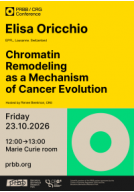
23/10/202612:00MARIE CURIEPRBB-CRG SessionsElisa OricchioEPFL"Chromatin Remodeling as a Mechanism of Cancer Evolution"Host: Renée BeekmanAbstract:Cancer is a disease that adapts and evolves in response to various growth conditions and environmental signals through genetic, epigenetic, and transcriptional modifications. The genetic evolution of a tumor occurs as a result of the gradual accumulation of genomic alterations, such as mutations and chromosomal abnormalities. However, tumors can continue to progress and develop resistance to treatments even without acquiring new genetic lesions, underscoring the importance of non-genetic mechanisms in tumor evolution. In my...
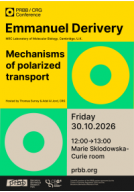
30/10/202612:00MARIE CURIEPRBB-CRG SessionsEmmanuel DeriveryMRC Laboratory of Molecular Biology"Mechanisms of polarized transport"Host: Thomas Surrey & Adel Al JordAbstract:Asymmetric cell division is the process by which one cell divides into two daughter cells that have different fates. Asymmetric division is the hallmark of stem cells: one daughter cell specialises to perform a specific function in the organism, while the other becomes another stem cell that retains the ability to divide. We are interested in understanding how cell fate determinants segregate asymmetrically during asymmetric division. Specifically, we focus on...

06/11/202612:00PRBB AuditoriumPRBB-CRG SessionsNicola TernetteUniversity of Dundee"Redefining the HLA-E Immunopeptidome - a new landscape for therapeutic targeting"Host: Eduard SabidóAbstract:HLA-E is a non-classical HLA molecule with limited polymorphism, making it an attractive candidate for broadly applicable immunotherapeutic targeting. Its peptide repertoire, however, remains poorly understood. Using immunopeptidomics, machine-learning assisted prediction, and biochemical validation, we uncover an extended HLA-E immunopeptidome comprising canonical and non-canonical peptides, including cancer-associated ligands shared across individuals and tumour types....
04/02/202715:00R_473.10_AULAGene Regulation,Stem Cells&Cancer Progr.Nicholas KatsanisTBCOne Plus One Equals ZeroHost: Tagliaferro, Barbara